
The Proper Way to Take a Distribution from a Checkbook IRA
by Peter Rizzo
A Compliance Guide for Self‑Directed Retirement Investors
Lately, we have had many clients take distributions directly from their LLC or Trust, only to correct the mistake, which takes time, requires compliance paperwork, and can raise red flags. We outlined the proper way to take a distribution from your Check Book IRA. This does not pertain to the Solo 401 (k) – That is a different process. For those of you whose bank account is at your custodian, they will deduct from that account, so no need to send a check to the IRA.
One of the major advantages of using a Checkbook IRA structure—whether through an IRA‑owned LLC or an IRA‑owned Trust—is the ability to invest quickly and efficiently. Investors can write checks, send wires, and close deals without waiting for the IRA custodian to approve every transaction.
However, when it comes time to take a distribution, the process must still follow standard IRA reporting rules. Even though the investor controls the LLC or Trust bank account, the IRS still considers the assets to belong to the IRA—not the individual.
The Fundamental Rule: The IRA Owns the Assets
Even when an IRA owns an LLC or Trust with its own bank account, the assets inside that entity are still retirement assets. The account holder may act as the manager or trustee, but the beneficial owner remains the IRA.
Relevant IRS authority includes:
- IRC §408(a) – Establishes Individual Retirement Accounts
- IRC §408(d)(1) – Distributions from IRAs are taxable to the recipient
- IRC §4975 – Prohibited transaction rules governing IRA interactions
The Proper Distribution Process
Step 1 — Determine the Distribution Amount
The investor first determines the amount to distribute. Distributions may involve cash, real estate, cryptocurrency, promissory notes, precious metals, or ownership interests in an LLC. The value must be based on the fair market value of the asset at the time of distribution.
Step 2 — Return Funds to the IRA Custodian
For cash distributions, the most common approach is to return funds from the IRA‑owned entity back to the IRA custodian before the distribution occurs.
Typical flow: IRA → IRA LLC / Trust → Custodian → Individual
The manager of the IRA LLC or trustee of the IRA Trust writes a check from the entity bank account payable to the IRA custodian. Once the funds are deposited into the IRA account, the distribution can be processed.
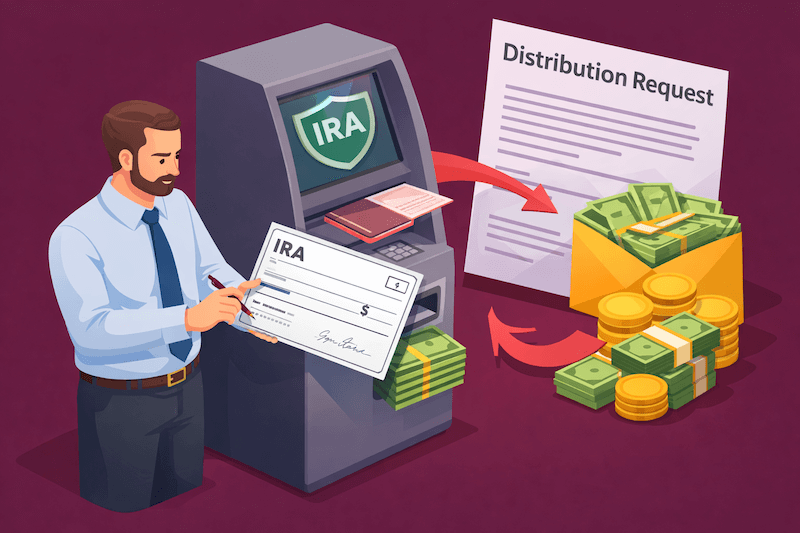
Step 3 — Submit a Distribution Request
The IRA holder submits a distribution request form to the custodian. The custodian then issues the distribution via ACH, wire, or check.
Step 4 — IRS Reporting
The IRA custodian reports the distribution on IRS Form 1099‑R.
Typical reporting codes:
- Code 7 – Normal distribution (age 59½ or older)
- Code 1 – Early distribution
- Code Q or T – Qualified Roth distribution
In‑Kind Distributions
A distribution does not always have to be cash. Investors may take an in‑kind distribution of an asset such as real estate, cryptocurrency, precious metals, or a promissory note.
The asset must be valued at fair market value, ownership must be transferred from the IRA entity to the individual, and the custodian reports the value on Form 1099‑R.
Common Mistake Investors Make
A common mistake occurs when investors simply write themselves a check directly from the IRA LLC account. This can create reporting problems because the custodian may not have documentation to issue a 1099‑R.
Routing distributions through the custodian helps maintain proper tax reporting and clean IRA recordkeeping.
CheckBook IRA Tip
Invest directly through the LLC or Trust—but process distributions through the custodian so proper IRS reporting occurs.
About CheckBook IRA
CheckBook IRA helps investors establish self‑directed retirement structures that provide greater control over alternative investments such as real estate, private lending, cryptocurrency, and private businesses—while maintaining compliance with IRS regulations.